
The oil and gas industry is facing a growing number of cybersecurity threats, with AI-powered threats on the rise.
These threats can come from various sources, including nation-states, cybercriminals, and malicious insiders. A successful cyberattack can devastate an oil and gas company, leading to financial losses, reputational damage, and even physical harm. One of the biggest challenges facing the oil and gas industry is the increasing complexity of its IT and OT infrastructure. This infrastructure is often spread across a wide geographic area, making it difficult to connect and secure with expensive, complex cybersecurity solutions.
BlastWave’s OT Zero Trust cybersecurity protection solution can help oil and gas customers with their most significant challenges:
Since BlastWave is more straightforward to purchase, install, and operate than other Zero Trust protection solutions, BlastWave takes 1/10th of the time, 1/2 the administrative lift in terms of management, and 1/4th the total cost of ownership.
BlastWave’s Zero Trust approach helps improve an oil and gas company’s overall security posture by reducing the risk of unauthorized access through credentials theft.
BlastWave reduces the attack surface by limiting access to remote resources through network cloaking and targeted network segmentation.
BlastWave helps oil and gas companies meet regulatory compliance requirements, especially with an IEC 62443 implementation of Zones and Conduits.
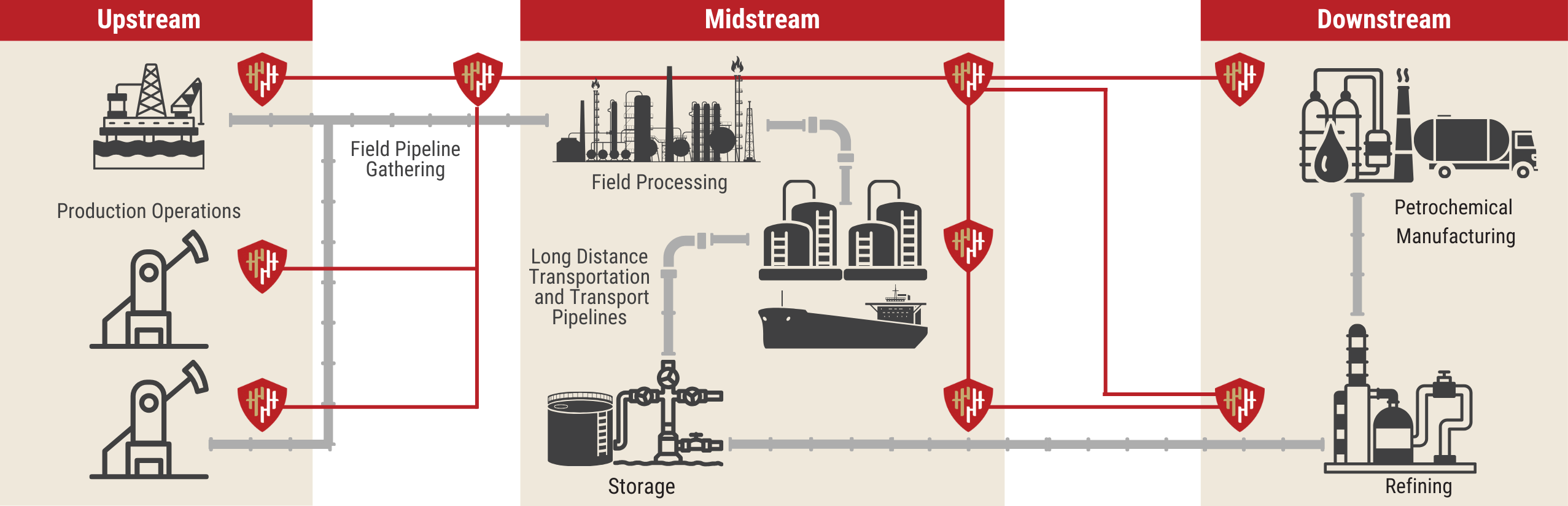
BlastWave’s OT cybersecurity for oil and gas is like having a multi-layered defense system protecting every part of your operation. Upstream (exploration and production) has secured remote rigs and sensors from sabotage and data theft. Midstream (transportation and storage) has protected pipelines and control systems from disruption and leaks. Downstream (refining and distribution) has secured refineries and terminals to prevent explosions, spills, and fuel disruptions. It’s all about keeping your people, assets, and the environment safe from cyber threats by securing connectivity and access.
Oil and Gas OT Networks with BlastWave
BlastWave’s OT Zero Trust Protection solution substantially benefits oil and gas companies, addressing critical security and operational challenges while driving cost efficiencies. By adopting a “never trust, always verify” approach, these organizations can:
Secure Connectivity
Oil and gas operations often involve remote sites, third-party contractors, and mobile workforces. BlastWave provides secure connectivity by verifying user and device identity before granting access to resources. Passwordless MFA and contextual authentication ensure that only authorized individuals can access sensitive data and systems, regardless of location. This is especially important for securing remote access to SCADA systems and other critical infrastructure.
Minimize the Attack Surface
OT networks in oil and gas are often complex and interconnected, making them vulnerable to lateral movement from compromised devices. BlastWave’s micro-segmentation capabilities restrict communication to only authorized connections, limiting the impact of a breach. By enforcing least privilege access, organizations can minimize the potential for attackers to gain access to critical systems.
Reduce Costs
BlastWave minimizes the need for costly, perimeter-focused security infrastructure. Traditional firewalls and VPNs often require significant hardware investments and ongoing maintenance. Companies can optimize resource allocation and reduce capital expenditures by implementing software-defined access controls and micro-segmentation. Moreover, they can avoid incident response, remediation, and potential regulatory fines by preventing costly breaches.
Improve Compliance
Oil and gas companies are subject to regulatory guidance like TSA and API standards. BlastWave facilitates compliance by providing granular visibility into network traffic and access patterns. Continuous monitoring and logging enable organizations to demonstrate adherence to regulatory requirements, simplifying audits and reducing the risk of penalties.
BlastWave’s Approach:
BlastWave implements a true Zero Trust architecture, assuming no user or device is inherently trustworthy. We verify every connection, enforce least privilege access, and continuously monitor network activity to detect and respond to threats in real-time. Our solution is designed to be easy to deploy and manage, minimizing disruption to existing operations.
By implementing BlastWave, manufacturers can strengthen their OT security posture, protect their critical assets, and ensure their facilities’ continuous and secure operation in the face of evolving cyber threats.

Deploy in the OT DMZ and cloak the OT network from AI-powered reconnaissance and CVE exploitation of legacy OT devices.
Connect remote sites and users with an encrypted software-defined network based on passwordless authentication and least privilege access.
Create software-defined security zones and conduits based on risk to mitigate exploits and lateral movement in the OT network.

Each oil and gas lifecycle segment has distinctly different cybersecurity requirements, which BlastWave uniquely solves to create anOT-specific security perimeter, adding to existing IT firewalls.
Upstream exploration and production require support for several remote devices at many sites. These devices require unattended operation with limited bandwidth and power. BlastShield’s small form factor, one-touch remote configurability, and highly cost-effective pricing make it a perfect fit. The software can be deployed on commodity hardware and hits a sub-$1000 target price per wellhead, a critical upstream oil and gas price point.
Remote site connectivity should use secure communications and access to the site should be restricted to authorized personnel. BlastShield enables secure connectivity from any central site to remote sites through individual remote site deployments or as a centralized macro segmentation solution ideal for Upstream.
Midstream transportation and storage solutions require 24/7 uptime with strong remote management and monitoring capabilities. The devices must be small in form factor, ruggedized, and low power, as remote sites often have limited power infrastructure and bandwidth, a perfect fit for BlastShield.
By leveraging BlastShield’s network cloaking, the Midstream remote sites are not discoverable from the rest of the OT network. This prevents reconnaissance from internal threats and protects them from hackers seeking to distribute ransomware into vulnerable legacy OT devices. BlastShield also secures access to remote pipeline sites and the more extensive storage and transportation hubs for midstream deployments.
Unlike other oil and gas lifecycle segments, the Downstream refining, processing, marketing, distribution, and sale of products require higher scalability and performance (including low latency) and stronger segmentation as maintenance contractors and temporary users are more involved in the logistics lifecycle.
BlastShield implements Zero Trust Protection to eliminate multiple classes of downstream risk. The solution combines the functionality of a cloaking firewall, Site-to-Site VPN, Remote Access VPN, Virtual Air Gap, and SD-LAN into a Zero Trust OT Perimeter Cybersecurity system perfect for OT networks.
BlastWave securely connects Industrial Control Systems, Operational Technology, and Critical Infrastructure networks with Zero Trust Protection and delivers industrial-grade cybersecurity with consumer-grade ease-of-use.
Learn how BlastShield™ delivers simple, effective, and cost-efficient Zero Trust OT cybersecurity for upstream, midstream, and downstream oil and gas systems.
Our Privacy Policy applies.

Getting started with BlastShield is easy and free. Follow the three steps below and get up and running fast.
%20(1).svg)
Create a Free Trial
Account
.svg)
Download the BlastShield Authenticator & Client
.svg)
Make Your Host Invisible
In Minutes
.svg)


Privacy Policy | Cookie Policy | © 2025 BlastWave, Inc. All Rights Reserved
This website uses cookies to ensure you get the best experience. More Info