
OT Secure Remote Access (SRA) is used when engineers and third-party contractors need to access critical systems from any location. The challenge for Operational technology organizations is bridging the gap between connectivity and high-assurance security without exposing themselves to attacks from AI-powered hackers, hostile nation-states, or criminals.
Operational Technology (OT) SRA enables remote users to interact safely with industrial control systems (ICS). Unlike traditional IT remote access, OT environments require specialized workflows:
For engineers utilizing customized control protocols and specialized applications.
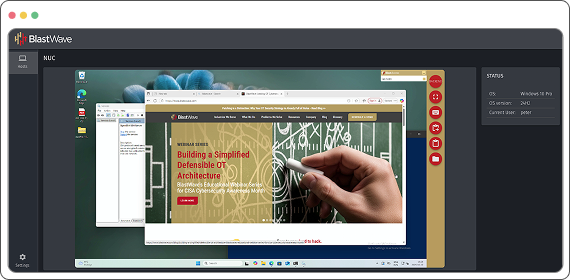
Low-latency access to Human-Machine Interfaces (HMI) or controller systems for real-time monitoring.
OT environments face unique challenges that traditional VPNs or IT-centric tools cannot address:
Many OT systems rely on unpatchable legacy hardware, making them permanent targets for exploitation.
Remote entry points often become the weakest link, allowing attackers to leverage compromised credentials to move laterally.
From AI-powered reconnaissance to sophisticated phishing, the threat landscape specifically targets the "human element" of OT access.
Maintaining compliance with IEC 62443, NERC CIP, TSA Security Directives, CMMC, and NIS2 requires verifiable, secure access logs and strict control measures. BlastWave publishes compliance mappings for each.
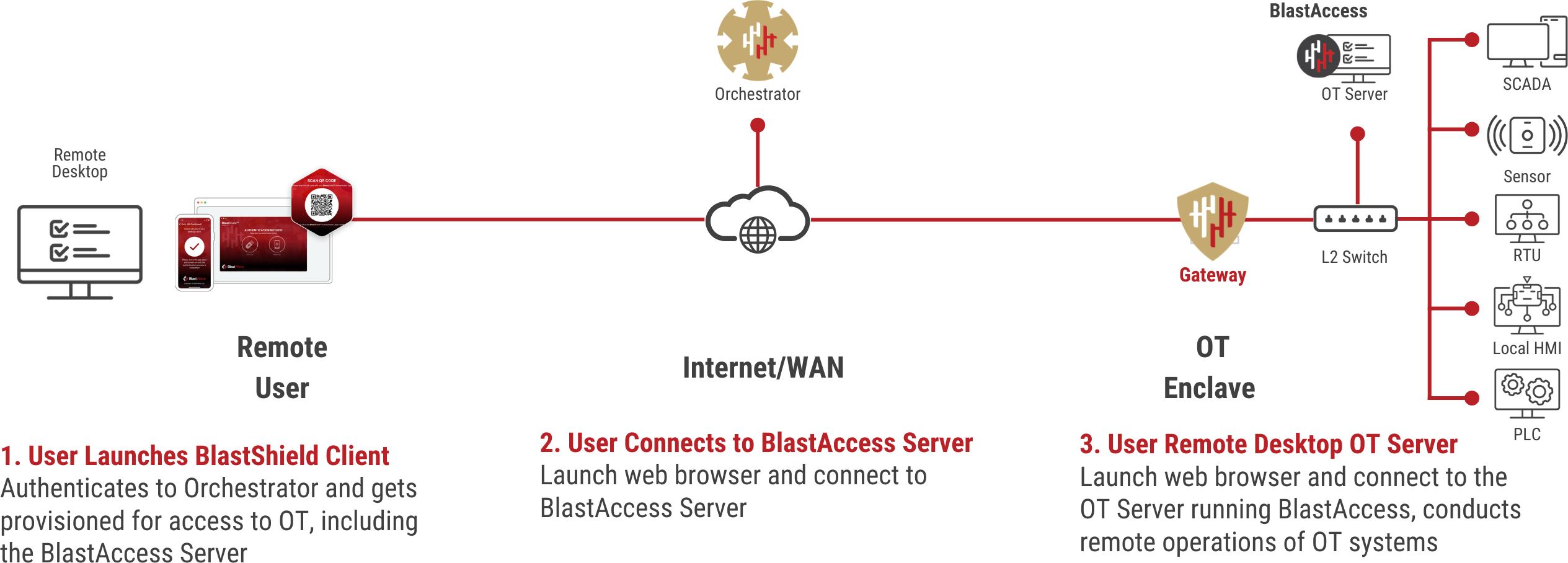
BlastWave’s BlastShield™ provides a transformative approach to Secure Remote Access by consolidating Zero Trust principles into a single, high-performance architecture.
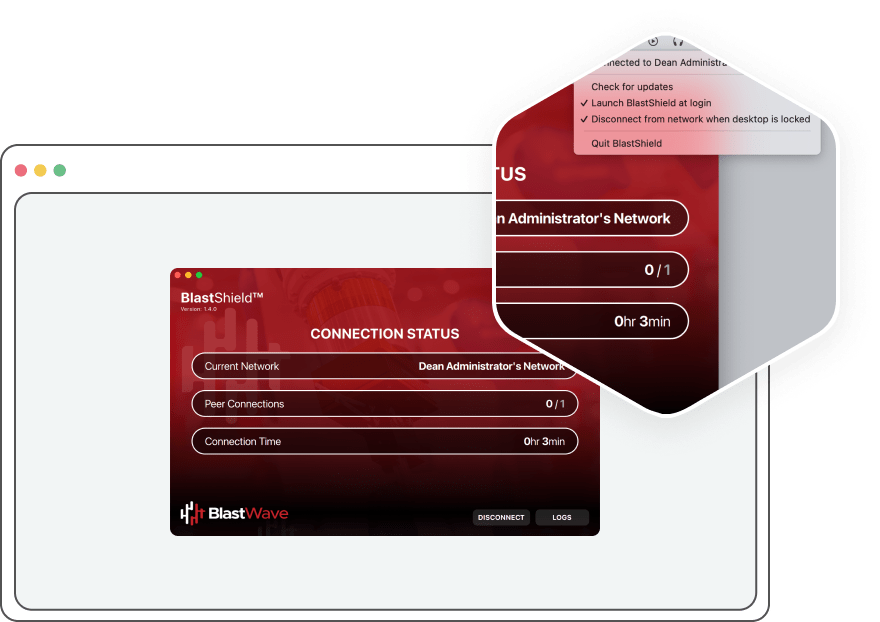
Every user and device is verified before a single packet is exchanged, effectively making the OT network invisible to unauthorized parties.

By utilizing phishing-resistant authentication, BlastShield eliminates credential theft, one of the most critical threat vectors in OT security today.

We enforce Least Privilege Access and segment the network to ensure that, even in the event of a breach, lateral movement is impossible.
The solution is designed to scale across tens of thousands of geographically dispersed OT systems and devices.
Insecure access isn't just a digital risk; it has physical consequences. By implementing BlastShield, organizations mitigate the risk of production downtime, equipment damage, and safety hazards in critical infrastructure. BlastShield and BlastAccess are both low-latency solutions, with no visible delay even for streaming video across low-bandwidth remote links.
Implementing OT Secure Remote Access requires a tailored approach that addresses the unique operational hurdles of different critical infrastructure sectors. Whether managing a global manufacturing floor or a remote oil rig, BlastShield™ provides the high-assurance security needed to maintain uptime and safety.
In manufacturing, OEMs and specialized contractors often require remote access to troubleshoot proprietary machinery.
Oil and gas operations often involve geographically dispersed assets, such as wellheads and pipelines, in environments where low latency is critical.
The energy sector is a primary target for state-sponsored actors, where a single breach can lead to widespread safety hazards.
Water utilities rely on SCADA systems to manage treatment and distribution, often with limited IT staff to manage complex security.
Experience the simplicity of BlastShield to secure your OT network and legacy infrastructure.
OT Secure Remote Access (SRA) lets engineers and third-party contractors safely access critical industrial control systems from any location. It bridges the gap between connectivity and high-assurance security without exposing the network to AI-powered hackers, hostile nation-states, or criminals.
VPNs grant implicit trust after login, provide broad network-level access, often rely on vulnerable passwords, and expose entry points that attackers can scan. Once the perimeter is breached, the risk of lateral movement across the OT network is high.
Privileged Access Management restricts user-to-device access and records sessions, but it provides no east-west protection inside the network. BlastShield applies never-trust-always-verify with least-privilege, application-level access, network cloaking that makes systems invisible to scans, and microsegmentation that prevents lateral movement.
By eliminating passwords, BlastShield removes credential theft — one of the most critical threat vectors in OT security today — as an attack path. Authentication combines a QR code challenge-response with localized biometric authentication and the device keystore, keeping a human in the loop.
Yes. Least Privilege Access creates an enclave for each contractor: technicians can only see and interact with the specific PLC or HMI they are assigned to maintain, leaving the rest of the network invisible. BlastAccess can restrict access further to a single remote desktop.
Yes. Interactive secure remote access with BlastAccess session recording provides the verifiable access logs and strict control measures required by regulations like NERC CIP, while still allowing engineers to use native industrial protocols and customized control applications.
A deployment process for Zero Trust remote access to OT networks: map access requirements, deploy the BlastShield Security Gateway, enroll users and devices, replace passwords with phishing-resistant MFA, enable session-recorded remote desktop, and enforce least-privilege enclaves.

.svg)


.svg)