
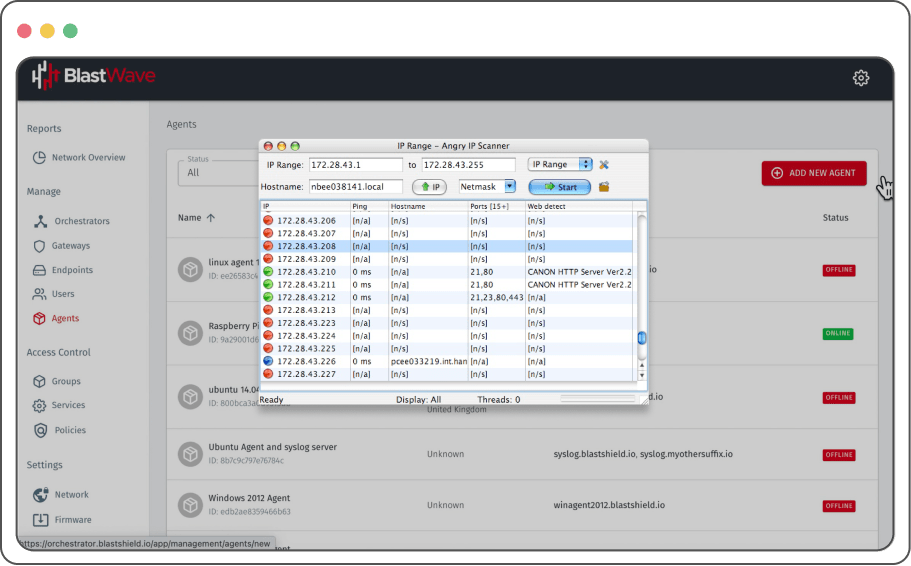
BlastShield is a zero-trust network access solution that helps organizations implement a zero-trust architecture.
Instead of relying on enhanced identity governance (EIG), complex layers of micro-segmentation, or cloud-based gateways, BlastShield utilizes a software-defined perimeter (SDP) approach for more granular access controls and reduced risk from stolen credentials and complex management.
Start a free trialThe BlastShield Gateway is a hardware-independent software appliance deployed inline in your OT network. It wraps every downstream asset in a Zero Trust perimeter that makes those assets unreachable without verified, authorized access, even from inside the network.
The BlastShield Orchestrator manages policy across your entire deployment, on-premises or in the cloud, distributing cryptographic keys and access rules to every Gateway and Client in real time. When a user's authorization changes, every Gateway in every facility updates in seconds.
Together, they replace the need for complex NGFW rule sets, VPN concentrators, jump servers, and VLAN-based segmentation, all while being simpler to deploy and maintain than any of those alternatives.
Protected OT assets do not respond to scans, pings, or probes. Censys has catalogued 145,000+ internet-exposed ICS services worldwide — a cloaked asset never makes that list.
Create isolated OT enclaves with Layer 2 separation: without VLANs, ACL changes, or firewall rule additions. Flat OT networks become segmented in hours. Lateral movement becomes impossible by design.
The Orchestrator distributes dynamic access policies to every Gateway in your estate simultaneously. No static rule sets to audit. No change tickets for access updates. Policies enforce in seconds.
Runs as a VM on your existing hypervisor, as a container in your OT DMZ, or as a pre-installed ruggedized appliance (OnLogic CL210G/K410, Axiomtek iNA110/ICO120) for harsh industrial environments.
All BlastAccess remote desktop sessions are recorded and accessible via integrated playback in the Orchestrator UI. Provides audit evidence for NERC CIP, IEC 62443, and NIS2 compliance programs.
No agent installation required on protected PLCs, RTUs, HMIs, or legacy Windows XP/7 systems. The Gateway provides protection at the network layer; legacy assets gain Zero Trust protection without any modification.
Several vendors now market some form of asset concealment. The useful question is no longer whether a product claims it, but where the concealment comes from and what it covers. Below is what each vendor publishes, in their own terms.
Concealment claim
How it is achieved
What it covers
Independent validation of the claim
BlastShield
Protected assets do not respond to unauthorized scans
Policy bound to the protected asset's cryptographic identity. The BlastShield Agent enforces on hosts that can run software; the Security Gateway authenticates on behalf of devices that can run nothing
An unauthenticated scanner on the same network segment
None published. Run the scan yourself: see below
Xage
Published. "Hide assets from unauthorized discovery, reconnaissance, and vulnerability scanning," announced August 2026
An XEP appliance placed in front of switches or devices. Xage's own datasheet titles the XEP a "Zero Trust Firewall." A second, catalogue-level mechanism states that "devices not included in the user's policy are not visible or accessible to them"
Traffic that traverses an XEP. The catalogue mechanism describes an authenticated user in a portal session. Xage's datasheet states that attempts to bypass the XEP generate an alert
None published
Zentera
Published. "OT assets become invisible to unauthorized scanning; no inbound firewall rules required"
A software overlay with Virtual Chambers. Hybrid model: agents where supported, agentless where not. Architecturally the closest approach to ours in the landscape
Framed around applications and workloads rather than industrial controllers
None published
Cyolo
Narrower. States its architecture renders assets "invisible to the public internet"
Outbound-only: a single outbound TCP 443 connection, no inbound firewall ports
The public internet, which is the scope Cyolo itself states
None published
Xona
Makes no asset-concealment claim. Positions as clientless, browser-based OT remote access
Critical System Gateway, which requires two IP addresses and a firewall rule
Session isolation for remote access, not asset concealment
n/a. Named an Overall Leader by KuppingerCole for OT/ICS Secure Remote Access
Claroty xDome Secure Access
Makes no concealment claim, by design. The value model requires assets to be discoverable
Maps Virtual Zones, then pushes policy to existing firewalls and NACs
Enforcement by integration. It does not replace the firewall; it requires one
n/a
NGFW platforms (Palo Alto, Fortinet)
Make no concealment claim
Filtering and inspection at a policy enforcement point in the traffic path
Prevention is signature and anomaly based, so it requires seeing the traffic, which requires the asset to be reachable
n/a
Nobody in this category, including us, has published third-party validation of a concealment claim. That is why our offer is a test rather than a datasheet: twenty minutes, a live port scan against an unprotected asset and the same scan against a protected one, side by side, while you watch. Run the same test against anyone on this list.
Concealment on its own is one function. The second question is what else you have to buy to complete the architecture.
Asset concealment
Credential elimination
Segmentation
Remote access
BlastShield
Yes, per Table 1
Passwordless MFA: QR challenge-response, local biometrics, device keystore. No password exists to steal or phish
Software-defined microsegmentation, no ACLs or VLAN re-architecture
Replaces VPN. No inbound open ports, no concentrator
Xage
Claimed, per Table 1
MFA is included. There is no passwordless, credential-elimination equivalent
Yes, as a separate product line
Yes. Six product lines in total
Zentera
Claimed, per Table 1
Identity delegated to existing IdPs. No passwordless equivalent, so upstream credential theft remains in scope
Yes, microsegmentation included
Yes, application-identity ZTNA
Cyolo
Public-internet scope only
Not covered here
No native segmentation. A separate product is required
Yes
Xona
Not claimed
Relies on integration with existing identity providers. No passwordless equivalent
None. No east-west control, and no protection for assets not currently being accessed remotely
Yes, browser-based. Native thick clients such as Studio 5000 or ROCLink do not run in a browser session
Claroty xDome Secure Access
Not claimed
Not covered here
By integration. Requires an existing firewall or NAC to enforce
Yes
NGFW platforms (Palo Alto, Fortinet)
Not claimed
Not covered here
VLAN and rule-based. Rule administration is the ongoing cost
VPN
Claroty's own research found that 55% of OT environments run four or more remote access tools and 33% run six or more. The consolidation argument is theirs, not ours.
What this comparison does not claim.
Every vendor here is competent and several are strong where we are not. Xage protects assets that can run nothing at all, and has federal and DoD program history we do not match. Xona has the cleanest compliance mapping in the category. Claroty's asset discovery is genuinely deep, and if you already run it, Secure Access is an incremental purchase. Fortinet ships the only full ruggedized hardware line in the industry.
We have not tested any competitor's product. Everything above is drawn from vendor documentation and analyst coverage published as of August 2026, and vendors ship new capability constantly. If a row is out of date, tell us and we will correct it.
Comparison current as of: August 2026. Reviewed 26 August 2026.
Deploy Gateways to create isolated enclaves for PLCs, DCS systems, and engineering workstations — without touching the underlying network. Production systems become invisible to plant floor workstations that don't need access to them.
Shield Windows XP HMIs, aging PLCs, and unpatched SCADA servers with a Zero Trust perimeter — no agent installation, no patching required. The Gateway enforces access controls at the network level.
Shield Windows XP HMIs, aging PLCs, and unpatched SCADA servers with a Zero Trust perimeter — no agent installation, no patching required. The Gateway enforces access controls at the network level.
Enforce Electronic Security Perimeters (ESP) and Remote Access Controls required by NERC CIP-005/007 and IEC 62443 security zones, with full audit logging and session recording built in.
OT Zero Trust Network Access (ZTNA) is a security architecture for operational technology environments in which no user, device, or connection is trusted by default, even within the network. Every access request is authenticated and authorized before any network-level connectivity is established. Unlike traditional VPNs that grant broad network access after login, OT ZTNA grants access only to specific authorized assets on a per-session basis, making everything else invisible and unreachable.
Firewalls protect the network perimeter by filtering traffic, but once an attacker bypasses the firewall (through phishing, a compromised vendor VPN, or a supply chain attack), they can move laterally across the flat OT network. BlastShield Gateway takes a fundamentally different approach: it makes OT assets invisible to unauthorized parties (network cloaking) and enforces microsegmentation that prevents lateral movement even after a perimeter breach. The asset itself is the perimeter, not the firewall in front of it.
No. BlastShield deploys as a software overlay on top of your existing network infrastructure, it does not replace your firewall, switches, or routers. You can deploy a BlastShield Gateway as a VM or container on existing infrastructure, or on a certified ruggedized appliance. No network topology changes are required. BlastShield works alongside your existing perimeter security and adds Zero Trust protection on top.
Yes, this is one of BlastShield's primary design goals. No agent installation is required on protected OT assets. The BlastShield Gateway provides network-level Zero Trust protection for any device behind it, including Windows XP HMIs, legacy PLCs, unpatched SCADA servers, and proprietary industrial controllers that cannot run third-party software. The protected assets gain full cloaking and access control without modification.
Palo Alto Networks and Fortinet both offer OT security capabilities built on traditional NGFW architectures, which require proprietary hardware, complex rule sets, and significant network redesign to achieve OT segmentation. BlastShield is hardware-independent, and deploys without network changes. BlastShield also deploys in minutes versus weeks for enterprise NGFW deployments. The trade-off: NGFW platforms offer broader network-layer inspection; BlastShield prioritizes simplicity, OT-native Zero Trust, and the elimination of the reconnaissance attack surface.
BlastShield Gateway supports compliance programs built on NERC CIP (Electronic Security Perimeters, remote access controls), IEC 62443 (zones and conduits), and NIS2. Session recording and audit logging provide evidence auditors ask for; they support, but do not replace, the controls and certifications each framework requires.
Start a free trial and make your PLCs invisible to network scanners before your next coffee break.
Our Privacy Policy applies.
Getting started with BlastShield is easy and free. Follow the three steps below and get up and running fast.
%20(1).svg)
Create a Free Trial
Account
.svg)
Download the BlastShield Authenticator & Client
.svg)
Make Your Host Invisible
In Minutes
.svg)


Privacy Policy | Cookie Policy | © 2026 BlastWave, Inc. All Rights Reserved
This website uses cookies to ensure you get the best experience. More Info
.svg)