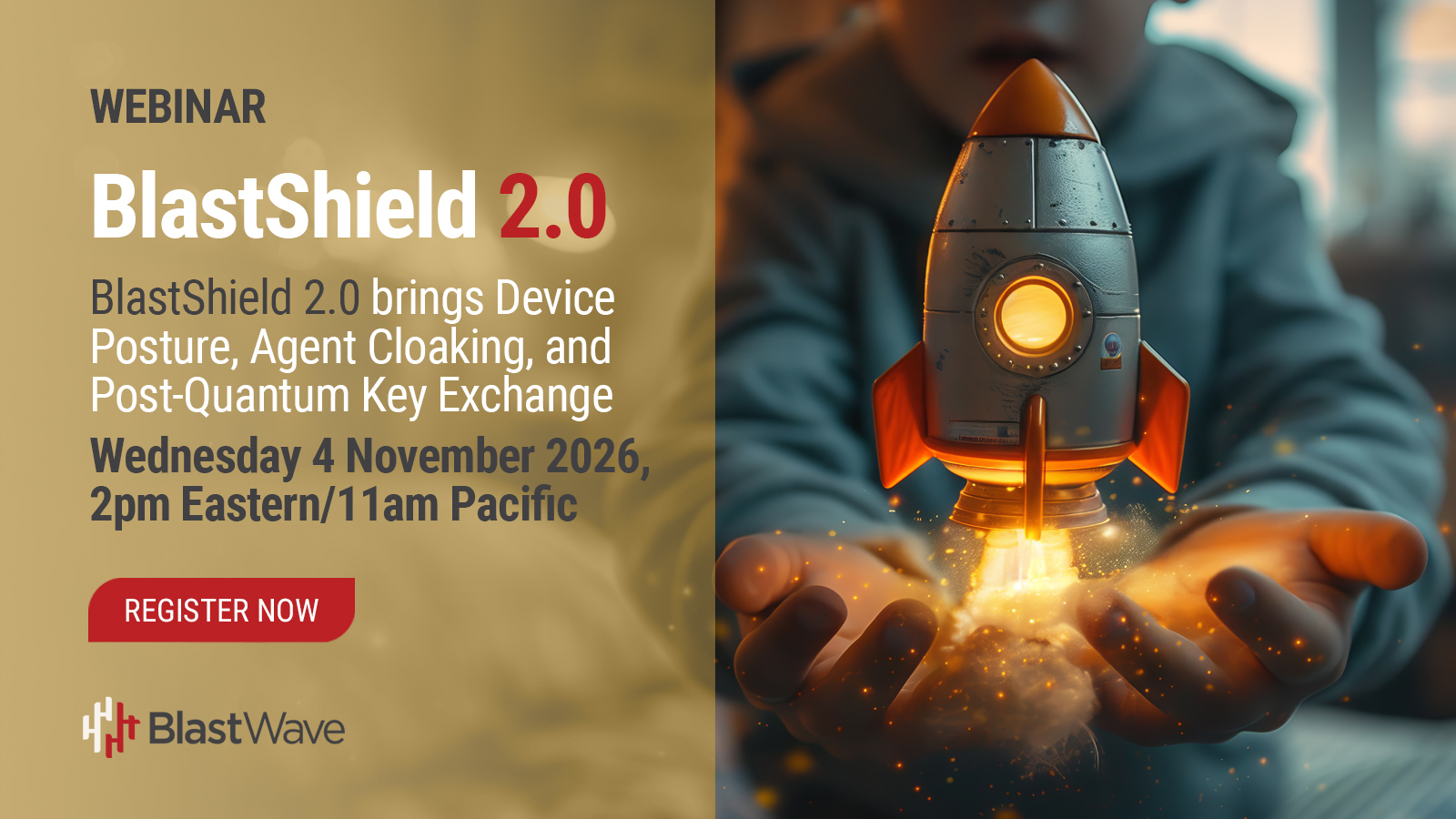
AI has automated reconnaissance and exploit development, so attackers find exposed systems faster and defenders have less time to patch. BlastShield 2.0 responds by changing what BlastShield checks before it grants access, how session keys are protected against harvest-now, decrypt-later attacks, and what remote access feels like for the people using it.
In this on-demand webinar, BlastWave CEO Tom Sego, CMO Cam Cullen, and Solutions Architect Joe Baxter explain what’s new, demonstrate each capability in the Orchestrator, and answer live questions about upgrading.
Cloaking now extends to the endpoint running the BlastShield Agent. A cloaked host drops unauthenticated traffic, so scanners can’t tell it from empty address space, and self-isolation lets it accept inbound connections only over BlastShield. The team also explains how these controls apply to recent attacks on refrigeration systems.
The Q&A covers how firmware updates can be scheduled for a maintenance window, how networks keep running while the Orchestrator restarts, and how high-availability pairs update one side at a time without interrupting service.
Water and wastewater utilities, manufacturers, federal and defense operators, and anyone who relies on contractors or remote support to keep OT systems running.
Schedule a personalized demo of BlastShield 2.0. We’ll scan a protected controller in front of you, then have an authorized operator reach the same device.
BlastWave makes networks easy to use and hard to hack.
Its platform combines Passwordless Industrial MFA and Software-Defined Microsegmentation to deliver Zero Trust security for complex OT and IT environments — without the cost or complexity of traditional tools.
BlastWave empowers enterprises to protect critical infrastructure, reduce the attack surface, and comply with industrial security standards such as IEC 62443 — all while minimizing downtime and deployment friction.