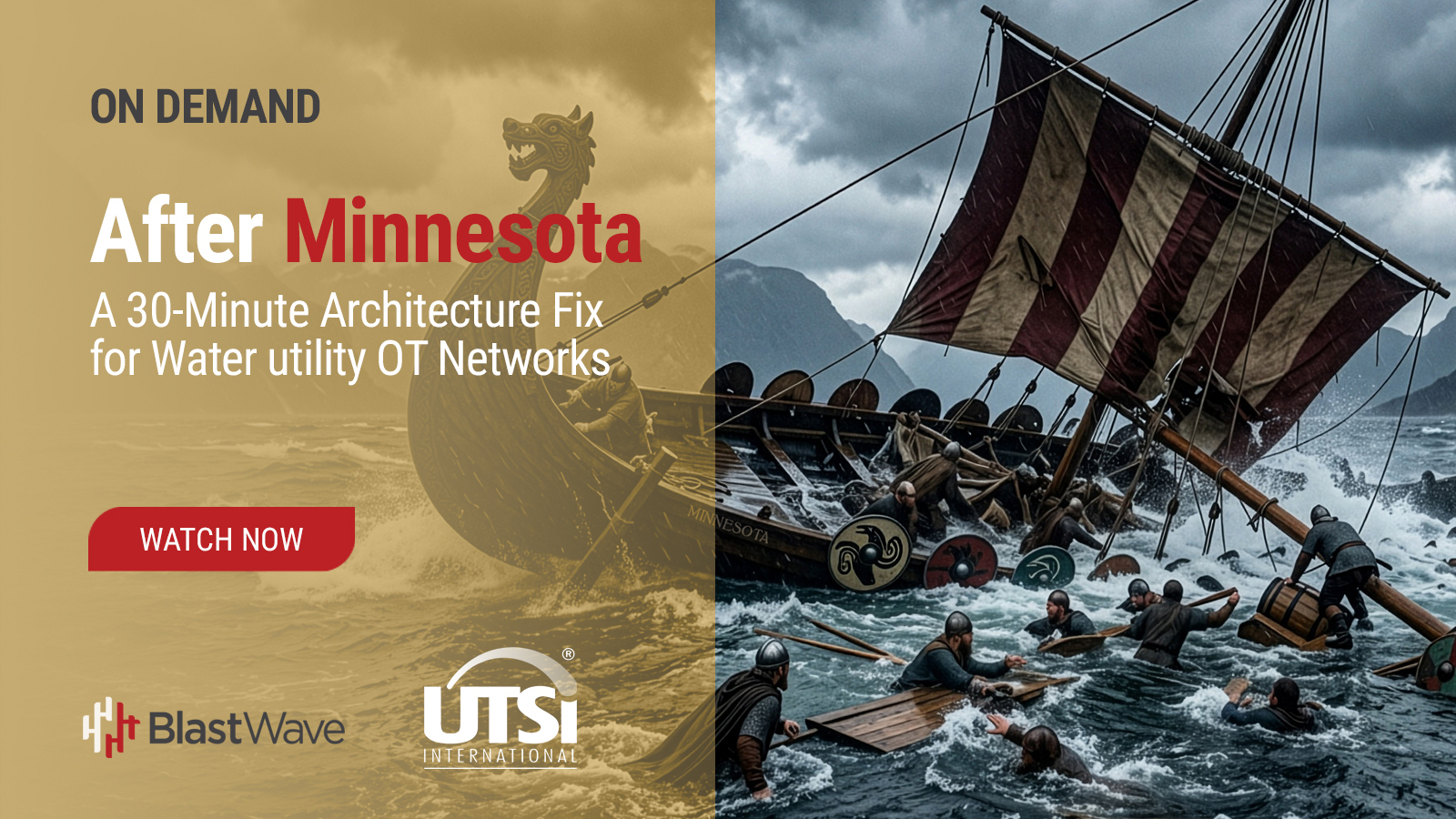
Attackers Can Weaponize a CVE in 10 Minutes. Your Network Can Simply Not Be There.

A veteran OT penetration tester spent a decade breaking into industrial networks. Then he hit one protected by BlastWave — and couldn't find a way in. Here's how to make your Ignition deployment the network that stonewalls the next attacker.
Watch the proof:
Or skip ahead: schedule a demo
500,000,000+ protected device hours. Zero successful hacks. Including professional penetration tests.
What is BlastShield for Ignition? BlastShield is BlastWave's OT security platform for Inductive Automation Ignition deployments. It removes the three things every attack needs: a visible target (network cloaking makes systems invisible to unauthenticated traffic), a stealable credential (passwordless biometric MFA eliminates phishing), and room to move (software-defined segmentation contains any compromise). It deploys over your existing flat network — no re-cabling, no re-IPing, and a sub-second cutover.
Why Did the Math on Your OT Network Stop Working?
Research shows AI tools can read a freshly published CVE and generate a working exploit in under 10 minutes. Your patch cycle — when a patch even exists — runs 200+ days. Every day in between, your exposure window is open, and attackers can walk through it at their leisure.
It gets worse. In the webinar above, OT penetration tester Aaron Boyd — 10+ years breaking into industrial environments, NSA alumnus — laid out exactly why:
- Your “air gap” has tendrils: remote access, vendor connections, cloud historians, MQTT pipelines, and shadow IT nobody documented. In a decade of testing, Boyd has found exactly one type of truly isolated network: research labs.
- Your protocols were built on the assumption that anyone on the network belongs there. No authentication. No encryption. By design.
- Your stack carries a “complexity tax” — decades of accumulated layers, and most asset owners can't even list the software running on their own devices.
- Over 90% of generic OT attacks involve stolen credentials (source: BlastWave's Hackopedia analysis of 23 of history's worst OT attacks). Every password in your environment is a door.
- Some of your “patched” systems aren't. Boyd has seen patches that only break the public proof-of-concept code — while the actual vulnerability lives on.
“Defenders have to play by rules. Attackers really don't.”
— Aaron Boyd, OT Penetration Tester
You can't out-patch this. You can't out-spend it with another detection dashboard. The attacker's clock runs in minutes; yours runs in quarters. The only winning move is to get off the clock entirely.
How Does BlastShield Protect an Ignition Deployment?
Ignition is secure by design — Inductive Automation publishes its practices on a public trust portal. But Ignition sits at the center of IT/OT convergence, moving data between the plant floor, ERP and MES systems, mobile devices, and the cloud. BlastShield protects everything around it — by removing what every attack needs:
1. A target they can see? Gone. (Network Cloaking)
Behind a BlastShield gateway, your systems cannot be pinged, scanned, fingerprinted, or provoked into any response until the requester authenticates via single-packet authorization. To reconnaissance tools — human or AI — your network is a void. That 10-minute AI exploit machine? It still can't exploit a target it cannot find. Reconnaissance is step one of every attack chain. Cloaking deletes step one.
2. A credential they can steal? Doesn't exist. (Passwordless MFA)
BlastShield replaces passwords with biometric, device-bound authentication — the same protected-enclave model as Apple Pay. BlastWave never stores biometric data; your device authenticates you, and the network trusts the key pair. A QR-code scan keeps a human in the loop, so nothing can be scripted. To hijack a session, an attacker needs root on the user's laptop, control of their phone's secure enclave, and a live QR interaction — simultaneously. Phishing stops being an attack vector, because there's nothing to phish.
3. Room to move? Sealed off. (Software-Defined Segmentation)
If a PLC gets compromised, segmentation stops the attacker from pivoting into your Ignition gateway and everything downstream. BlastShield builds zones in software over your existing flat network — no VLANs, no re-cabling, no re-IPing, no downtime. Segment by site, by function, or device-by-device for IEC 62443. One customer estimated the firewall route at two years. Customers deploy BlastShield zones in hours.
Bonus: the unpatchable, protected.
That Windows 98 machine still running production? (Yes, it's real — we showed the photo in the webinar.) Behind an agentless BlastShield proxy, it can only speak specific protocols, to specific systems, for specific users, at specific times. Its attack surface shrinks from “the internet” to “authorized insiders only” — no patching required, because patching becomes irrelevant.
What Happened When a Pen Tester Attacked a BlastWave Network?
Aaron Boyd runs annual penetration tests for a longtime customer. He knows their network — he's beaten it before. Then they deployed BlastWave:
“After banging my head on the wall more than I've ever banged my head, I'm like, 'What did you guys do?' … Everything I was able to identify and correlate on the network — hostnames, network traffic, credentials — it was all obfuscated. I had no idea what I was looking at. I wasn't able to find an entryway in. It completely changed the game.”
— Aaron Boyd, OT Penetration Tester
He could see traffic — and do nothing with it. He couldn't move past his entry point. Because he wasn't in any access policy, the network gave him nothing. He was so impressed he called BlastWave to find out what they were doing. Now he speaks on our webinars.
We'll be straight with you: nobody stays undefeated forever, and anyone promising perfection is selling something. But with no passwords to steal, no management interface to attack, and nothing visible to scan, an attacker has to solve several very hard problems at once instead of one easy one. Across half a billion protected device hours — including professional pen tests — no one has.
What Results Have Customers Actually Gotten?
- Two years, compressed to hours. A customer's IEC 62443 segmentation project was quoted at two years with firewalls, VLANs, and re-IPing. With software-defined zones: deployed in hours, zero downtime, zero hardware changes.
- An acquisition absorbed without a blink. One customer added hundreds of remote sites and tens of thousands of devices from an M&A deal with essentially no downtime — the only interruption was a sub-second failover from the old firewall to BlastShield.
- Remote access people actually use. BlastWave's client and Blast Access remote desktop were chosen by customers specifically for outrunning the RDP and PAM tools they replaced — which matters, because slow security is how shadow IT gets born.
- Latency your alarms won't notice. Engineered out on purpose. In some plants, added delay trips alarms and emergency systems — so BlastShield doesn't add it.
One avoided hour of downtime can pay for five years of BlastShield. When downtime runs hundreds of thousands to millions of dollars per hour, the ROI math is short.
See your network disappear: schedule a live demo and watch a scan of your protected segment return nothing: blastwave.com/schedule-a-demo
Hackopedia has 23 entries. Let's keep it that way.
Frequently Asked Questions
Q: What is BlastShield for Ignition?
A: BlastWave's OT security platform for Ignition deployments. It removes the three things every attack needs: a visible target (network cloaking), a stealable credential (passwordless biometric MFA), and room to move (software-defined segmentation) — deployed over your existing network with a sub-second cutover.
Q: What is network cloaking?
A: Systems behind BlastShield can't be pinged, scanned, fingerprinted, or provoked into any response until the requester authenticates via single-packet authorization. Reconnaissance is step one of every attack; cloaking deletes step one. Even AI-accelerated tools can't exploit what they can't find.
Q: Does deployment require OT downtime?
A: No. BlastShield deploys in parallel; the cutover is a sub-second failover. One customer absorbed hundreds of remote sites and tens of thousands of devices from an acquisition with essentially zero downtime.
Q: Our legacy gear can't run agents or patches. Can it be protected?
A: Yes. The agentless proxy protects unpatchable systems — down to that Windows 98 box — by controlling exactly who and what can talk to them, over which protocols, and when. The attack surface shrinks from “the internet” to “authorized insiders only.”
Q: Where do employee biometrics get stored? Legal will ask.
A: Nowhere. BlastWave never sees or stores biometric data — users authenticate to their own device's secure enclave (the Apple Pay model), and the network trusts the key pair. Delete a profile, or let time-bound access expire, and access is fully severed with nothing sensitive left behind.
Q: Vendors and integrators need remote access. That's non-negotiable.
A: Agreed — nobody drives 100 miles into the West Texas desert to flip a switch. Each vendor gets fast, passwordless access locked to exactly the segment they're authorized to touch, on access that expires automatically. Faster than your current VPN-and-jump-host maze, and far more contained.
Q: We already have a firewall. Why isn't that enough?
A: So did the victims of the recent firewall-appliance breaches — where attackers stole the firewall's own admin password and got the keys to everything. Over 90% of generic OT attacks involve stolen credentials. BlastShield has no passwords to steal and no exposed management interface to attack; admin access requires authenticating twice — the old Unix “su” discipline, rebuilt for OT.
Q: Isn't AI going to beat all of this eventually?
A: AI accelerates reconnaissance and exploit development — it doesn't conjure targets out of the void. Every AI-assisted attack still starts by finding something to attack. A cloaked network gives it nothing to find. That's why cloaking gets stronger, not weaker, as attackers get faster.
Q: Does BlastShield add latency?
A: No — engineered out on purpose, because in some plants added delay trips alarms and emergency systems. Customers chose BlastWave's remote access tools specifically for being faster than the RDP and PAM tools they replaced.
Q: What's the ROI?
A: When downtime runs hundreds of thousands to millions per hour, one avoided hour can pay for five years of BlastShield. And segmentation projects quoted in years deploy in hours — that's cost avoidance before the first attack is ever stopped.






American Water’s cyber incident shows why water utilities need stronger OT isolation to stop IT breaches from threatening critical infrastructure operations and availability.
Explore the complete analysis of 23 OT attacks that defeated firewalls, VPNs, and air gaps.
.svg)
.svg)